Case study · Web development & software · France · 2024
From Design to Maintainable Front-End Code
A role combining front-end development and UX consulting to bridge client needs, design decisions, and technical implementation, creating interfaces that are clear, maintainable, and built to evolve.
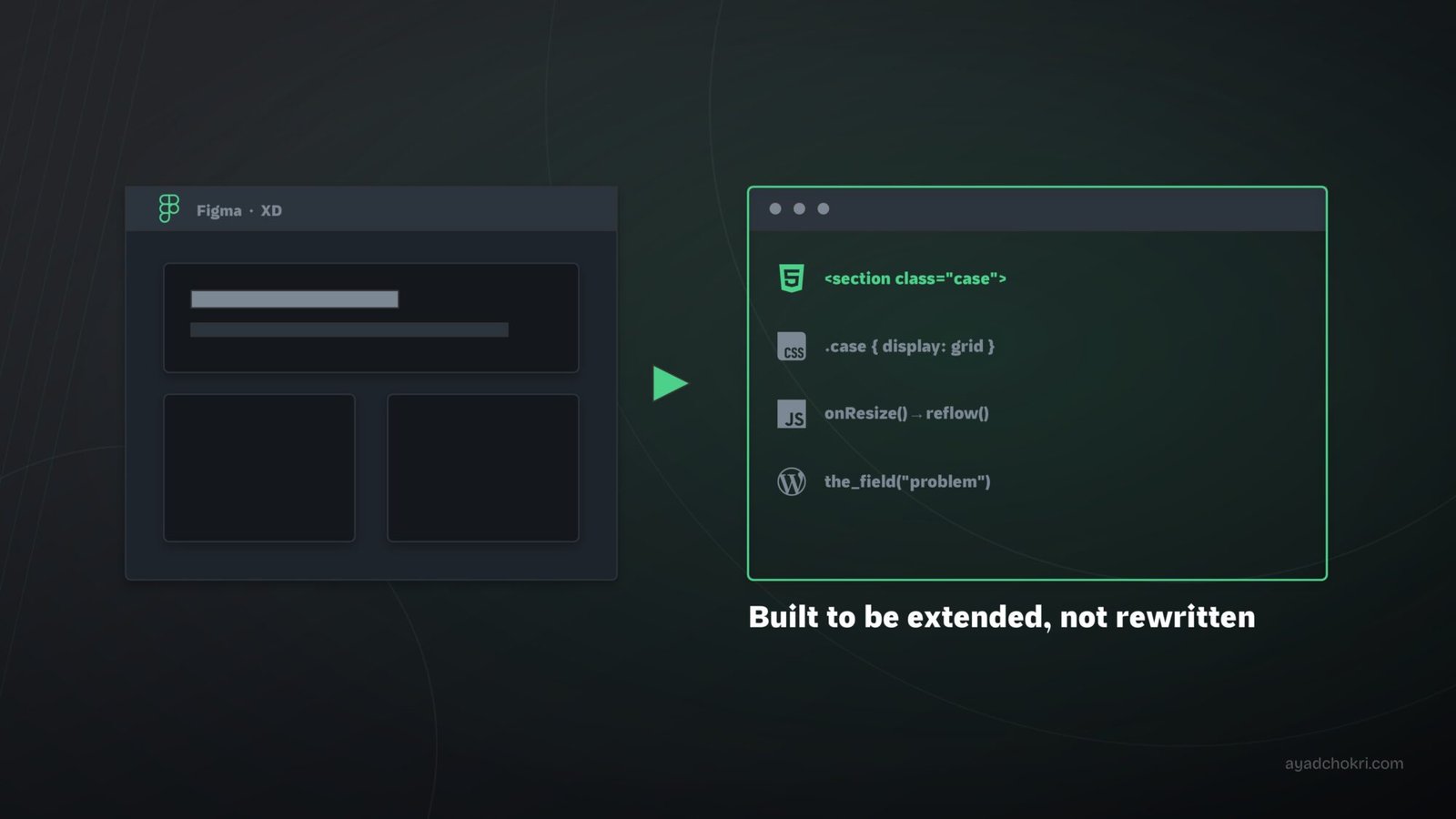
Client identity and visual materials are kept confidential. Selected visuals are presented for illustrative purposes only.
01 — Context
A French software development company delivering digital projects for clients through distributed teams. I worked as a Front-End Developer and UX Consultant, operating between the designers who defined the interfaces and the developers who turned them into working products.
With experience across both design and development, my role went beyond implementing screens from design files. I translated designs into clear structures for developers, defined components, states, and responsive behavior, and reviewed the built interfaces to ensure that the final result preserved the intended experience while remaining maintainable.
The core value of the role was bridging the gap between the client’s actual needs, the design decisions, and the technical implementation. A good interface should not only survive handoff, but remain understandable and extensible when another developer takes over the work.
02 — The problem
Designs were delivered to developers in a distributed working environment, often without the designer being present during implementation. A design file typically showed specific screens and states, while the actual product needed to handle many more situations: empty states, loading, errors, long and short content, different screen sizes, and cases that had never been explicitly designed.
When these decisions were left undefined, developers had to interpret the design and fill in the gaps themselves. Their implementation might be technically valid, but could gradually move away from the intended experience through dozens of small decisions.
There was also a second challenge in the structure of the code itself. An interface that works well today can become difficult to maintain when its underlying structure is unclear or overly dependent on the person who built it. Future developers then have to work around the existing code or rebuild parts of it, increasing the cost of maintaining the same interface.
03 — What I did
I treated the design as a system rather than a static image. Before writing code, I identified recurring components, their different states, and the relationships between them. Whenever an important decision was not defined in the design, I raised the question and connected it back to the actual user need and project context rather than making assumptions silently.
I then translated those decisions into a structure that other developers could work with easily. I focused on predictable naming, reusable components, and a codebase that did not require the original developer to explain how everything worked. For me, front-end quality is not only about matching the design. It is also about making it easy for the next developer to understand and extend the interface.
Responsive behavior was treated as part of the design decision rather than something left to the browser. When a design specified only a few fixed screen sizes, I defined what should happen between them, including how components, content, spacing, and layouts should adapt.
Throughout development, I reviewed the built interface against the original design from both a visual and functional perspective, checking accuracy, usability, responsiveness, and maintainability. The objective was not simply to reproduce the design, but to make sure the agreed experience became a working interface that could continue to evolve.
The work was carried out remotely and in French, with direct coordination between designers and developers and involvement in both design and technical decisions whenever leaving something undefined could create problems later.
04 — Result
The interfaces I delivered could be extended by other developers without needing to be rebuilt from scratch. This became one of the clearest indicators of success: the objective was not simply to deliver a polished interface, but to leave behind a solid foundation that the wider team could continue building on.
The role also helped maintain the quality of the experience across the gap between design and development, reducing the number of decisions left to interpretation during implementation. The collaboration continued for five years, with projects and interfaces being maintained and extended by different members of the team.
The impact on my own practice was equally important. Writing front-end code made me more aware of the implementation cost of design decisions, while my UX background helped me make development decisions based not only on how to build the interface, but on why the interface existed in the first place.
This work is covered by client confidentiality agreements through the company I worked with, so I do not name specific projects or show private materials from them. What I share here is the nature of my role and the approach I applied to the work.
Start a Project
Have a project in mind? Let's talk about what you need.
Whether you are defining a new digital product, improving an existing experience, building a website, or need support with a specific digital project, send me a brief overview and I'll suggest the best way forward.
A short brief is enough to start. I'll get back to you within two working days.
Direct
What happens next
- I read the brief and reply within two working days
- A 30-minute call to understand the situation
- A written proposal with scope and a fixed price